Sub-Zero serviceCustom panels
Custom-panel Sub-Zero doors that sag, gap or won't close
A panel-ready Sub-Zero door carries a slab of cabinetry, sometimes solid oak or walnut with raised molding. When that door drifts, gaps or refuses to latch, the cause is usually mechanical rather than a cooling fault, and the fix is usually made with the panel left exactly where your cabinetmaker hung it.
4.9 of 5 · 187 client reviews How we are rated
The sagging door in a few sentences
Why is my Sub-Zero panel door sagging?
Because the hinges carry the whole weight of the panel every time the door swings. Over time a heavy wood face pulls the hinge out of adjustment, the door drops on the handle side, and the reveal against the neighboring cabinets turns uneven. Resetting the hinge and closer to the panel's real weight usually brings it back level.
A door that weighs as much as a cabinet
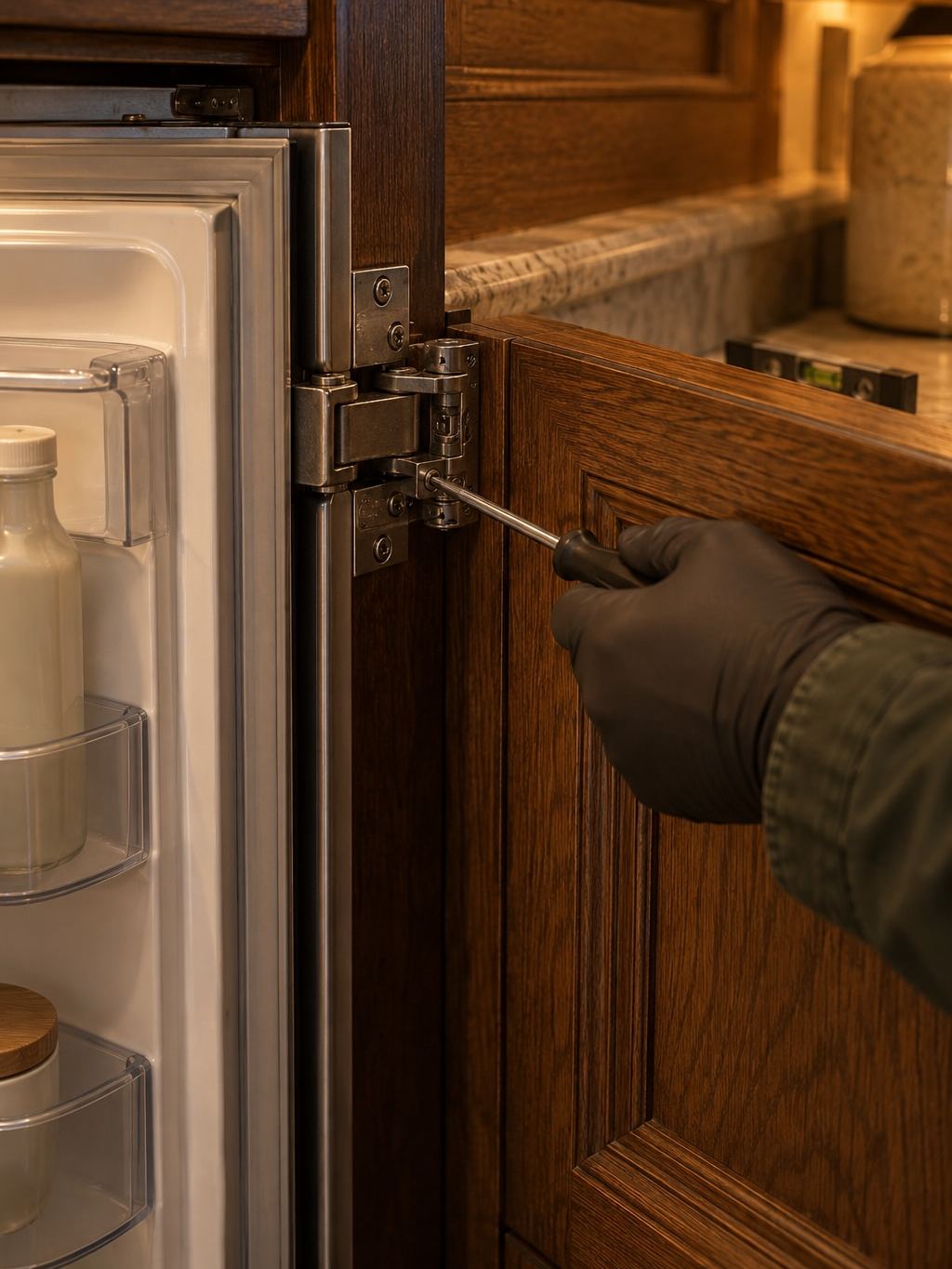
On a stainless Sub-Zero the door arrives as one engineered piece. On a panel-ready model the appliance supplies the door frame, the hinge and the closer, and your cabinetmaker adds the face. That face can be anything from a thin painted board to thick hardwood with applied molding and substantial pulls. The hinge is adjustable to cope with all of it, but it has to be set for the panel actually mounted, and wood keeps moving with the seasons long after installation day.
That is why panel doors drift. A setting that was perfect when the kitchen was finished may not suit the door after a few humid summers and dry winters, after a heavier pull is bolted on, or after children swing on the freezer drawer. The door closes a little short, the gasket loses its even pressure, and only then does the cooling side begin to suffer: frost along one edge, beads of moisture, a compressor running more than it should.
On every visit we separate those two problems. If the refrigeration is healthy and the door is the culprit, the work is mechanical: hinge, closer, mounting hardware, gasket. If the door seals well and the unit still runs warm, the panel is a bystander and the job becomes a refrigeration repair, the kind described on our refrigerator restoration page.
Reading the door before the thermostat
Most panel complaints announce themselves at the door long before any temperature changes. Here is how the common signs usually sort out.
- Panel sits lower on the handle side
- Hinge pulled out of adjustment by the panel's weight
- Reveals between the panel and nearby cabinets grow uneven
- Door dropped or twisted; sometimes the panel has shifted on its own mounting screws
- Door drifts back open or stops just short of closing
- Closer tuned for a lighter door, a bent hinge arm, or a shelf item pushing on the liner
- Frost builds along one inside edge
- Gasket no longer pressing evenly because the door does not sit square Related service
- Moisture on the panel edge or the cabinet beside it
- Cold air slipping through a gap, or warm air trapped behind a panel with no path to vent
- Scuffs, chips or rub marks on the finish
- The door edge or panel touching a neighboring cabinet as it swings
- Unit runs nonstop although the door seals tightly
- Probably not the panel at all: condenser airflow or a refrigeration fault Related service
When a new panel stops the door closing
Why won't my Sub-Zero door close after installing a custom panel?
The hinge and closer are often still set for a lighter door, so the added weight overpowers the closing mechanism or drops the door until it catches on the frame. Mounting screws that run too long, or a panel cut slightly oversize, can also bind against the cabinet. Adjusting the hinge for the new weight usually cures it.
How we work on a panel-ready door
Panels normally stay on. If taking one off is genuinely needed, we explain why first, protect the finish and go ahead only once you agree.
-
Protect the finish
Pads go down on the floor and across the adjacent cabinet faces, and gloved hands handle the panel edges. Tools never rest on painted or stained surfaces.
-
Assess the hinges and the panel mount
We check hinge play, the screws holding the panel to the door, and whether the panel itself has shifted, split or swollen. From the front, a loose mount and a worn hinge can look identical.
-
Set the closer to the weight
Hinge and closer tension are adjusted for the panel actually hanging on the door, so it swings smoothly, pulls itself shut from partway open and stays level.
-
Check the ventilation paths
Built-in units breathe through the grille and the openings around the toe kick. We confirm that the panel, the trim and any added molding have not closed those paths off.
-
Test the gasket seal
With the door square again, we check gasket contact around the full perimeter, look for frost tracks and confirm the temperatures settle where they belong.
-
Hand woodwork to your cabinetmaker
If the panel is cracked, warped or cut to the wrong size, we write down exactly what we saw so the person who built it can correct it. We repair the appliance; the joinery stays with the woodworker.
What a door that won't latch does not mean
-
HeardIf the door won't close, the refrigerator is failing.
In practiceMore often the refrigeration is fine and the problem is purely mechanical. Leave it long enough, though, and the weak seal starts to cost you: frost, condensation and a compressor working overtime.
-
HeardThe panels have to come off for any repair.
In practiceHinge adjustment, closer work, gasket replacement and most refrigeration diagnostics happen with the panel in place. Removal is the exception, and we talk it through with you first.
-
HeardA heavier panel always means a better kitchen.
In practiceA heavier panel simply asks more of the hinge. It can hang beautifully for a long time, provided the hinge is set correctly and looked at about once a year.
Can a panel-ready Sub-Zero be repaired without removing the panels?
In most cases, yes. Hinges, closers, gaskets, the condenser behind the grille and most control and refrigeration diagnostics can be reached with the panels mounted. When a repair truly requires taking a panel down, we explain why, protect the finish and wait for your go-ahead before touching it.
Panel questions from owners and their designers
- How often should the hinges on a heavy panel door be checked?
- Once a year is a sensible rhythm for heavy hardwood panels, and any time a door starts to drift, gap or bounce back open. It is a short check that fits easily into an ordinary service visit.
- Will you work with our cabinetmaker if the panel itself is the problem?
- Yes. We handle the appliance and report what we found on the panel side: the mount, the fit, any splitting or swelling. Your cabinetmaker then corrects the woodwork, and we readjust the hinge afterwards if the panel's weight has changed.
- We are planning panels for a new Sub-Zero. Who should we talk to?
- That is a planning question rather than a repair. Our estate kitchen consultation looks at panel weight, ventilation paths and service access while the cabinetry is still on paper.
- How do I look after custom panels between visits?
- Gentle cleaning, no harsh solvents near the gasket, and a habit of noticing how the door closes. We cover the details in our article on caring for Sub-Zero custom panels.
- What does a visit for a sagging panel door cost?
- The trip is $89, charged once for the visit even if we check several Sub-Zero units, and it counts toward the repair. Adjustment or part costs are quoted after the technician inspects the door, before any work. See our pricing page for how quotes are built.